


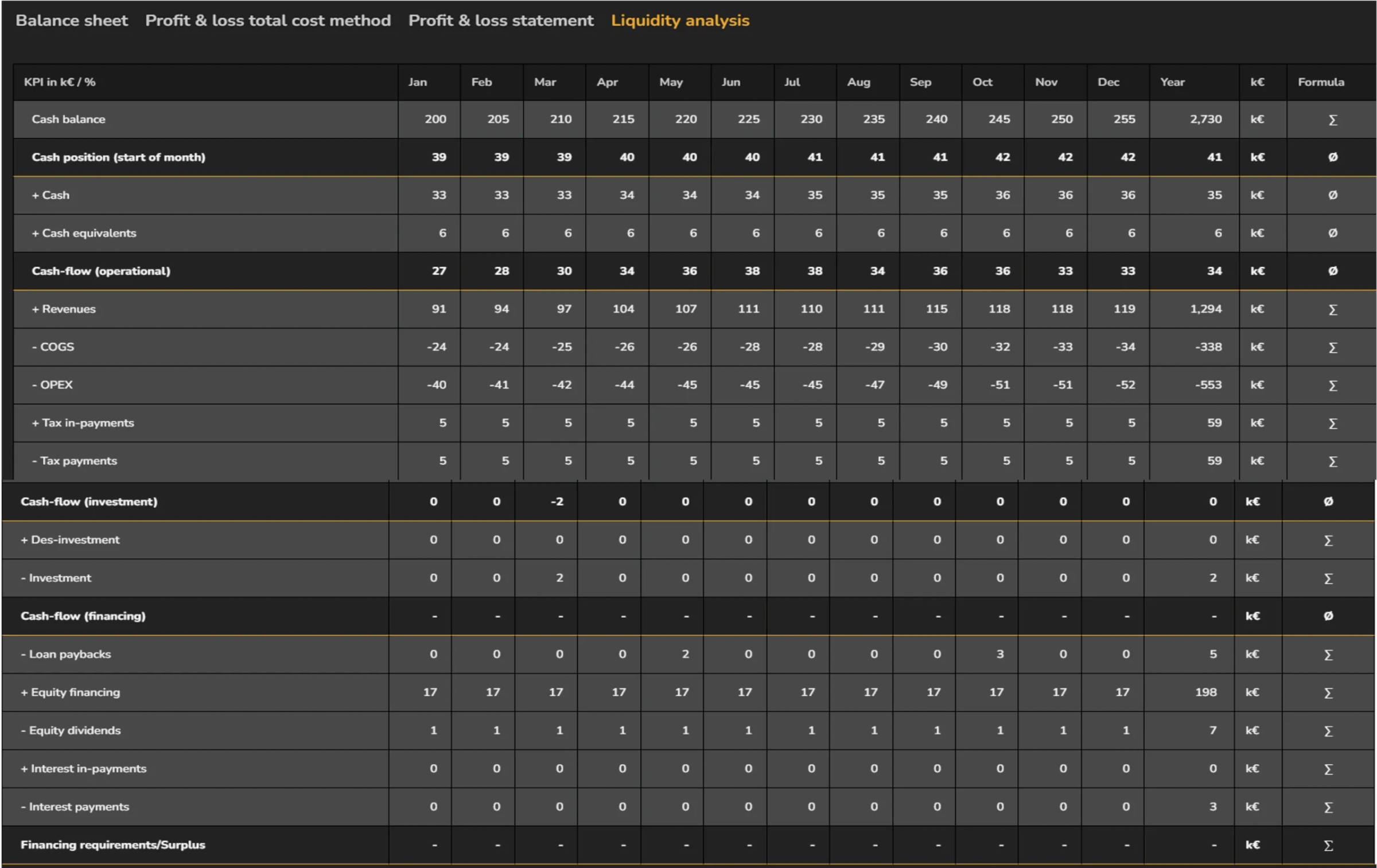
Liquidity planning for mid-sized companies maps expected cash receipts and payments over time so finance teams can assess available cash before commitments fall due. When information comes from several systems, the bank balance alone is not enough. You need to know when customers will actually pay and when obligations must be settled.
Key takeaways
- Liquidity planning follows payment dates, not the month in which revenue is recognised.
- Reconcile opening balances, outstanding invoices and planned payments before testing scenarios.
- Keep existing cash separate from undrawn credit facilities.
- ValueWorks connects cash flow forecasting with financial planning; your team still validates the data and assumptions.
Why liquidity planning matters for mid-sized finance teams
A signed order does not pay salaries. The order, delivery, invoice and cash receipt are different events. If your finance team merges those dates, the forecast can look healthier than the actual cash position.
Liquidity planning therefore answers a different question from a profit forecast: not simply whether the business is profitable, but whether cash is available when it is needed. The rolling forecast guide, available in German, explains how to update the broader financial outlook regularly.
For your 2026 planning cycle, check how those views connect. A new hire affects both personnel expenses and cash payments. An investment can require an immediate payment even when its effect on profit is spread over time. Put those connections into the model rather than explaining them after a decision has been made.
The Chamber of Commerce and Industry for Munich and Upper Bavaria describes liquidity planning as comparing receipts and payments according to when they fall due. This guide applies that principle to finance teams working with several operating plans. It does not assess the financial position of any individual company.
How to build a reliable liquidity plan
1. Define the decision and planning horizon
Start with a simple spreadsheet. Write down the decision the plan needs to support: understanding payment obligations, preparing an investment or checking the funding available for recruitment. Choose the time periods only after that decision is clear.
A short-term view covering 13 weeks and a monthly view covering 12 months are possible starting formats, not universal requirements. The short-term view highlights payment peaks; the longer view captures operating changes. Reconcile the point where the two meet so the same payment does not move or disappear between them.
If you are setting up the process in 2026, avoid unnecessary detail in the longer-term outlook. An exact payment date creates false confidence when the underlying contract has not been agreed. Identify uncertainty explicitly instead of hiding it behind precise calendar dates.
- State the management decision the forecast must inform.
- Select a horizon long enough to cover that decision.
- Choose weeks or months as your planning periods.
- Agree the information cut-off and update frequency.
- Identify uncertainties that need separate scenarios.
2. Reconcile the available opening balance
Record the cash actually held at the planning date. Assign bank accounts and any relevant cash balances to the correct business entity. Check which funds are freely available and which cannot be used for ordinary payments without further conditions.
An undrawn credit facility is not a bank balance. Show unused funding separately and consider the conditions attached to it. Financing that you expect to arrange must not be treated as money already received. This distinction reveals which assumption is supporting the projected cash position.
For a group with several companies, a consolidated total does not always answer the operational question. Cash in one entity is not automatically available to another. Confirm the practical and legal basis for transfers before using them as a source of funding in the plan.
- Reconcile all balances to the same cut-off date.
- Document restrictions on access to cash.
- Separate existing balances from unused borrowing capacity.
- Assign each account to the correct entity.
- Check both sides of intercompany payments.
3. Build cash receipts from traceable sources
Begin with outstanding customer invoices. Use contractual due dates, but also review known delays and disputed amounts. An overdue receivable does not become more certain because someone moves it into the following week.
Next, add expected receipts from future delivery. Define a clear boundary between invoiced receivables and business that has not yet been invoiced. Without it, one cash receipt can appear twice: once in accounts receivable and again in the revenue plan. Document the handover between those sources.
ValueWorks supports revenue forecasting and cash flow forecasting using different data sources. Your team still needs to define how operating information becomes an expected receipt. An automated import does not establish when a customer will actually pay or whether a commercial assumption remains realistic.
- Start with reconciled outstanding receivables.
- Flag overdue and disputed invoices.
- Keep existing invoices separate from future business.
- Incorporate known payment arrangements.
- Record the source and owner of each material assumption.
4. Schedule cash payments when they will happen
Bring in outstanding supplier invoices and add commitments that have not yet been booked. Agreed payroll payments, rent and planned capital expenditure are examples. The absence of an accounting entry does not mean that a payment is not approaching.
Review recurring payments separately from one-off items. Do not spread an annual insurance payment across the year simply because the profit forecast recognises a monthly expense. Liquidity follows the actual cash outflow. Apply the same discipline to deposits and agreed instalments.
Include taxes, loan repayments and other relevant movements using reliable information. This guide does not provide statutory deadlines or company-specific tax amounts. Confirm those inputs with the responsible specialists instead of accepting generic assumptions from a template.
- Capture existing commitments and those not yet booked.
- Check payment schedules for capital expenditure.
- Reflect personnel changes from the relevant payment date.
- Distinguish recurring payments from exceptional outflows.
- Prevent duplication between invoices and the expense plan.
5. Calculate balances and explain their movement
The calculation is straightforward: opening cash plus receipts minus payments equals closing cash. That closing figure becomes the next period's opening balance. The formula is simple; completeness and timing determine whether the result is useful.
A positive month-end balance does not prove that cash is sufficient throughout the month. If salaries are paid before a large customer receipt arrives, the monthly total can hide a temporary gap. Use a finer time resolution where payment peaks make that distinction material.
Your 2026 liquidity plan should explain changes, not just display them. Why does the lowest balance arrive earlier than it did in the previous version? Which customer is expected to pay later? Which investment has been brought forward? A clear cause is more useful than an unexplained warning in a dashboard.
- Carry closing balances into the next period correctly.
- Check signs and payment-period assignments.
- Inspect periods containing concentrated cash outflows.
- Separate operating, investment and financing movements.
- Explain material differences from the previous forecast.
6. Test scenarios with clear triggers
Save the base case with its date and assumptions. Then change one defined input, such as the timing of a customer payment. Hold the other inputs constant so the reason for the difference remains visible.
For a pilot, you can use 3 scenarios: the base case, a delayed customer receipt and an additional investment payment. These are suggested test cases, not predictions about your business. Each scenario should answer a real management question rather than merely producing a different chart.
Connect the result to a practical response. Who checks the receivable? By when must financing be confirmed? Which expenditure is genuinely deferrable? Do not quietly count an unconfirmed action as certain relief in the base case. An option is not the same as an agreed measure.
- Change a clearly identified assumption for each test.
- Use the same opening data across scenarios.
- Compare the level and timing of the lowest cash balance.
- Name the decision the scenario requires.
- Record the owner and next review date.
7. Make updates repeatable
Specify who reconciles bank information, who checks outstanding invoices and who confirms operating assumptions. Without ownership, even a technically sound forecast becomes stale. A scheduled review helps only if the required information is ready.
Close past periods with actual cash movements. Compare them with the previous forecast before rolling it forward. Distinguish an incorrect amount from a payment that simply moved to a different period. Those causes require different adjustments and should not disappear into a general variance explanation.
For the ongoing process in 2026, a documented change history is more valuable than an apparently flawless snapshot. Retain approved versions and explain significant revisions. Management can then see which new information requires a different decision rather than being presented with an unexplained replacement forecast.
- Agree a consistent information cut-off.
- Reconcile cash actually received and paid.
- Explain variances by cause.
- Retain the approved forecast version.
- Extend the forward horizon after each completed period.
Spreadsheet or software: which approach fits?
A spreadsheet works for a defined starting scope with a small group of contributors. It makes calculations directly inspectable. Its limit is not a particular company size; it is the point where data transfers, ownership and parallel versions are no longer controlled reliably.
A shared planning platform becomes relevant when several operating plans and data sources need to be combined regularly. ValueWorks offers cash flow forecasting alongside personnel, expense, investment and revenue planning. Test the required sources and mappings against your actual data rather than assuming that a connection solves every modelling question.
| Approach | Best for | Strength | Limitation |
|---|---|---|---|
| Controlled spreadsheet model | A clearly defined planning scope | Calculations and assumptions can be inspected directly | Imports, reconciliation and versions need explicit controls |
| Integrated planning with ValueWorks | Finance teams with connected operating plans | Cash flow and operating financial plans can be considered together | Data connections and model logic require setup and validation |
ValueWorks supports mid-sized finance teams that need to connect liquidity planning with revenue, personnel and investment plans. This describes the intended use, not a promise of specific time savings or financial outcomes.
Common liquidity planning mistakes
Treating revenue as a confirmed cash receipt
A revenue plan is not a list of confirmed bank transactions. Review invoicing conditions, agreed payment terms and known delays. Keep uncertain new business identifiable as an assumption rather than letting it appear as guaranteed cash.
Combining credit facilities and cash balances
A single total hides the actual financing requirement. Show funds already held and available borrowing separately. Give proposed financing its own status until conditions and disbursement are confirmed. That makes dependence on additional funding visible.
Looking only at year-end cash
The lowest balance can occur well before year-end. Review the path and the underlying payment dates. A positive closing figure does not replace ongoing monitoring, especially where large receipts and obligations fall in different weeks.
Counting unconfirmed actions as completed
A possible payment extension or a deferrable investment is not an agreed cash improvement. Separate confirmed measures from open options. Otherwise, the base case depends on decisions nobody has actually made.
FAQ
What belongs in a liquidity plan?
A liquidity plan includes available opening cash and expected receipts and payments at their respective payment dates. Include relevant investment, tax and financing movements as well.
How is liquidity different from profit?
Liquidity describes available cash; profit describes the economic result for a period. Revenue and expenses can be recognised at different times from the associated cash receipts and payments.
How far ahead should a mid-sized company plan liquidity?
The appropriate horizon depends on your decisions and cash risks. A short-term weekly view and a longer monthly outlook can complement one another, provided their opening balances and assumptions reconcile.
Can I start liquidity planning in Excel?
Yes, a controlled spreadsheet is a suitable starting point for a manageable scope. Define data sources, ownership and version controls from the beginning.
How should I treat overdue receivables?
Assess their expected payment dates separately. Do not automatically move overdue invoices into the next period without a reason supported by current information.
Is a credit facility part of the bank balance?
No, an undrawn facility is not cash already held. Show financing capacity separately and check the conditions governing its availability.
Does planning software replace financial review?
No, software does not replace validation of data and assumptions. The finance team remains responsible for mapping, plausibility checks and interpretation.
One last check: timing matters as much as the amount
Before approving the next forecast, move the largest expected customer receipt into a later period in a separate scenario. Check which decision changes as a result. This focused test can reveal a dependency that an annual total conceals.
For liquidity planning in 2026, filling every cell is not the goal. Your team needs to explain when a cash shortfall appears and which confirmed measure addresses it. Signs of acute payment difficulties also require individual financial and legal assessment.
Related resources
- Financial planning software selection guide, in German.
- Planning and forecasting with ValueWorks.
- Book a demo to discuss your financial planning.
Editorial: ValueWorks. Updated November 2026. Methodological source: Chamber of Commerce and Industry for Munich and Upper Bavaria, liquidity planning guide, accessed 9 November 2026; scope: business cash movements and planning principles. This article does not replace individual tax, financial or legal advice.


