


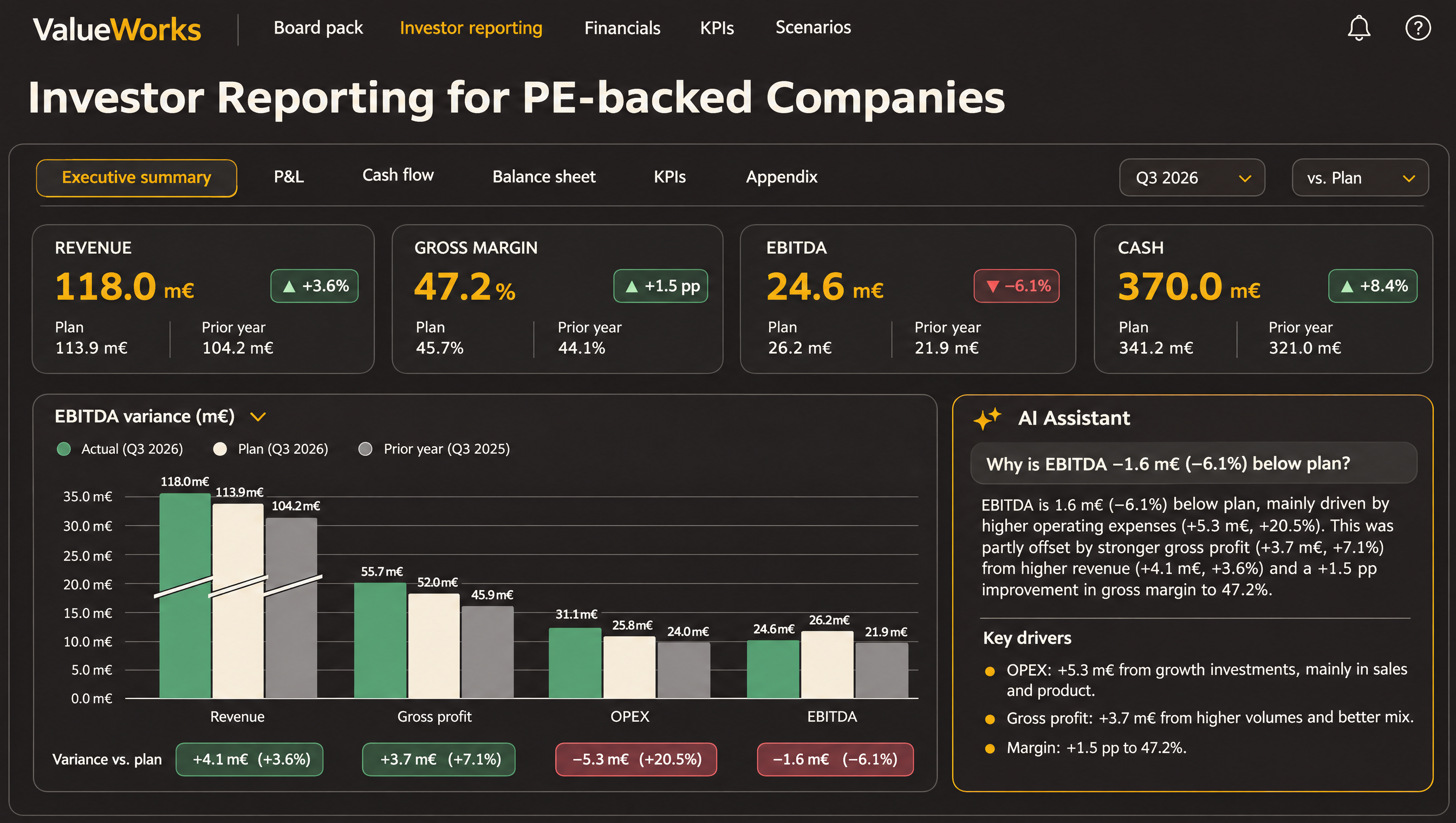
Investor reporting in a PE-backed company answers the same question every month: is the business on track against the value creation plan, and if not, why? For CFOs, the format is rarely the hard part. The hard part is that the numbers come from ERP, accounting, CRM and Excel and have to be pieced together again before every meeting.
Key takeaways
- Good investor reporting shows variances against plan and explains them, instead of only listing actuals.
- Consistent KPI definitions matter more than a polished layout.
- Answering board questions live builds investor confidence.
- A clean KPI history from day one makes the exit easier later.
What investors expect from PE-backed companies
After a transaction, the rhythm of the finance function changes. Instead of annual accounts and occasional bank meetings, the investor expects regular, comparable numbers. The operating partner wants to see whether the initiatives in the value creation plan are working. The board wants to understand where the business stands against budget and prior year.
At fund level, many European private equity firms follow the Invest Europe Investor Reporting Guidelines when they report to their own investors. The numbers behind that reporting come from the portfolio companies. The clearer and more consistent your reporting, the fewer questions arise on the way from the company to the fund and on to the limited partners.
In practice, investors mainly expect three things:
- Reliability: the same KPI means the same thing every month.
- Speed: reporting arrives a few days after month-end, not weeks later.
- Explanation: variances are explained, and it is clear what happens next.
Common problems in investor reporting
1. Data from many systems
Revenue sits in the ERP, pipeline in the CRM, personnel costs in the HR system and cash at the bank. Every month, exports are pulled, reconciled and copied into a presentation. Every manual step is a source of errors, and the knowledge of how it all fits together often sits with one person.
2. Inconsistent KPI definitions
What counts as recurring revenue? Is EBITDA reported before or after one-off items? If these questions are not answered and documented once, the numbers change with whoever calculates them. To the investor it looks like a performance problem, even though it is a definition problem.
3. "I'll follow up"
A reasonable question comes up in the board meeting, for example about margin by customer segment. The data exists, but not in the deck. The CFO promises to follow up. Once is fine. When it becomes the norm, trust suffers.
4. Variances are understood too late
EBITDA is below plan. It takes days to work out whether price, volume or cost is the cause. Often the explanation only arrives when the next month is almost closed.
How to build reliable investor reporting
1. Clarify the purpose and the audience
Agree with the investor which decisions the reporting should support. A board needs a different level of detail than an operating partner tracking initiatives. Define who receives which version and how often.
2. Define a fixed KPI set
Choose a small number of KPIs that reflect the value creation plan, for example revenue growth, gross margin, EBITDA, cash conversion and the two or three operating drivers of your business model. Document the definition, data source and owner for each KPI.
- Write down the definition and calculation logic.
- Name a single data source for each KPI.
- Version any change to a definition and tell the investor.
3. Show actuals, plan and prior year side by side
Investor reporting without comparison is just a list of numbers. Show every KPI against budget, forecast and prior year. Highlight material variances and agree in advance above which threshold a variance must be explained.
4. Explain variances, don't just show them
Break key KPIs down into their drivers. A driver tree shows whether an EBITDA variance comes from revenue, gross margin or cost, and where exactly. Add one sentence on the cause and one on the planned action for every material variance.
5. Look at liquidity separately
Profit and cash are not the same. Especially in leveraged structures with covenants, the investor wants to see how cash and headroom develop. A rolling liquidity plan belongs in the reporting. Our guide to liquidity planning for mid-sized companies shows how to build one.
6. Automate the data foundation
The biggest lever sits before the presentation. When actuals flow automatically from source systems and rely on shared definitions, the finance team's work shifts from collecting numbers to explaining them. That shortens preparation and makes board questions answerable live.
Investor reporting and exit readiness
The exit is where the quality of ongoing reporting shows. Buyers and their advisers ask for several years of KPI history and check whether the numbers can be traced. If you have to reconstruct that history for the data room, you lose time and risk discussions about valuation.
Reporting built on clean source data and documented definitions from the start creates that history as a by-product. Read more in our whitepaper Exit Readiness, Continuously Measured.
How ValueWorks supports PE-backed CFOs
ValueWorks connects ERP, accounting, CRM, HR and banking systems through 50+ integrations, including DATEV, SAP, HubSpot and Personio. Magnus, the ValueWorks AI assistant, builds the data pipelines and first dashboards in hours. Investor reporting, planning and liquidity then run on the same live data. Your finance team still reviews and validates the results.
In the board meeting, you can ask Magnus questions in plain language, such as why EBITDA is behind plan, and get an answer based on your connected data. Learn more on our page FP&A software for PE-backed CFOs.
Frequently asked questions about investor reporting
How often should a PE-backed company report to its investor?
A monthly management report to the investor is common, with a more detailed pack for board meetings. The exact cadence is usually set out in the investment agreement or agreed after the transaction.
Which KPIs belong in investor reporting?
At a minimum, revenue, gross margin, EBITDA and liquidity against plan and prior year. Add the operating drivers defined in the value creation plan, such as customer retention, pricing or order intake.
Do we need our own data team?
Not necessarily. What matters is a data foundation fed automatically from source systems and based on fixed definitions. Platforms like ValueWorks do the technical groundwork, so no internal IT project is needed.
One last check
Take your latest investor report and ask a question it does not answer, for example the margin of your largest customer segment compared with last quarter. How long would it take to answer that reliably? The answer shows where your reporting stands today.
Related resources
- FP&A software for PE-backed CFOs
- Value creation software for operating partners
- How to build a rolling forecast
- Book a demo
Editorial: ValueWorks. Updated November 2026. Methodological background: Invest Europe, Investor Reporting Guidelines (reporting by private equity funds to their investors). This article does not replace individual tax, financial or legal advice.


